Getting a smile makeover is a massive deal. But there's a quiet anxiety many patients share behind closed doors.
Will getting veneers give me chronic bad breath?
We've all been there. Standing next to someone with dental work that has a noticeable, unpleasant odour. Honestly, it’s enough to make you second-guess the whole idea of cosmetic dentistry.
Let’s clear the air right away. Dental veneers do not cause bad breath. Period.
The rumor that porcelain naturally rots over time? That's a complete myth. Think about it, high-quality dental ceramic is basically glass. It’s inorganic. It literally cannot decay, which means it definitely can't emit odours by itself.
So, if your breath starts taking a turn for the worse after treatment, something else is going on. Usually, it boils down to trapped bacteria hiding out in microscopic gaps, an imperfect fit around the gumline, or just missing the mark on daily flossing.
Here's the real story behind why some dental work develops a smell over time, and exactly how our clinical protocols at Land of Smiles in Jakarta help prevent it from happening to you.
The Real Culprit: Trapped Bacteria and Micro-Gaps
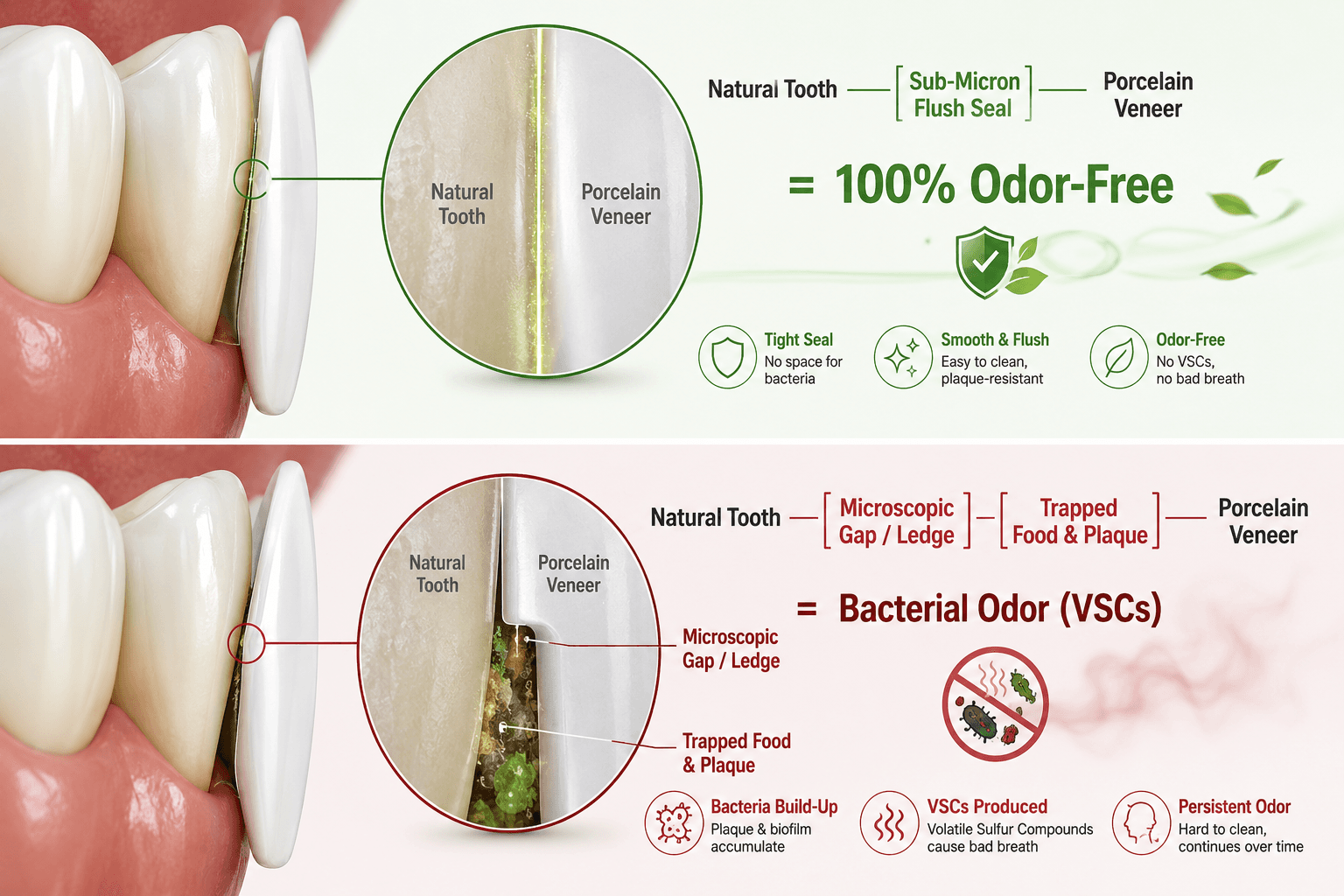
To figure out bad breath (halitosis), look closely at the exact point where your natural tooth meets the veneer. Dentists call this the "margin."
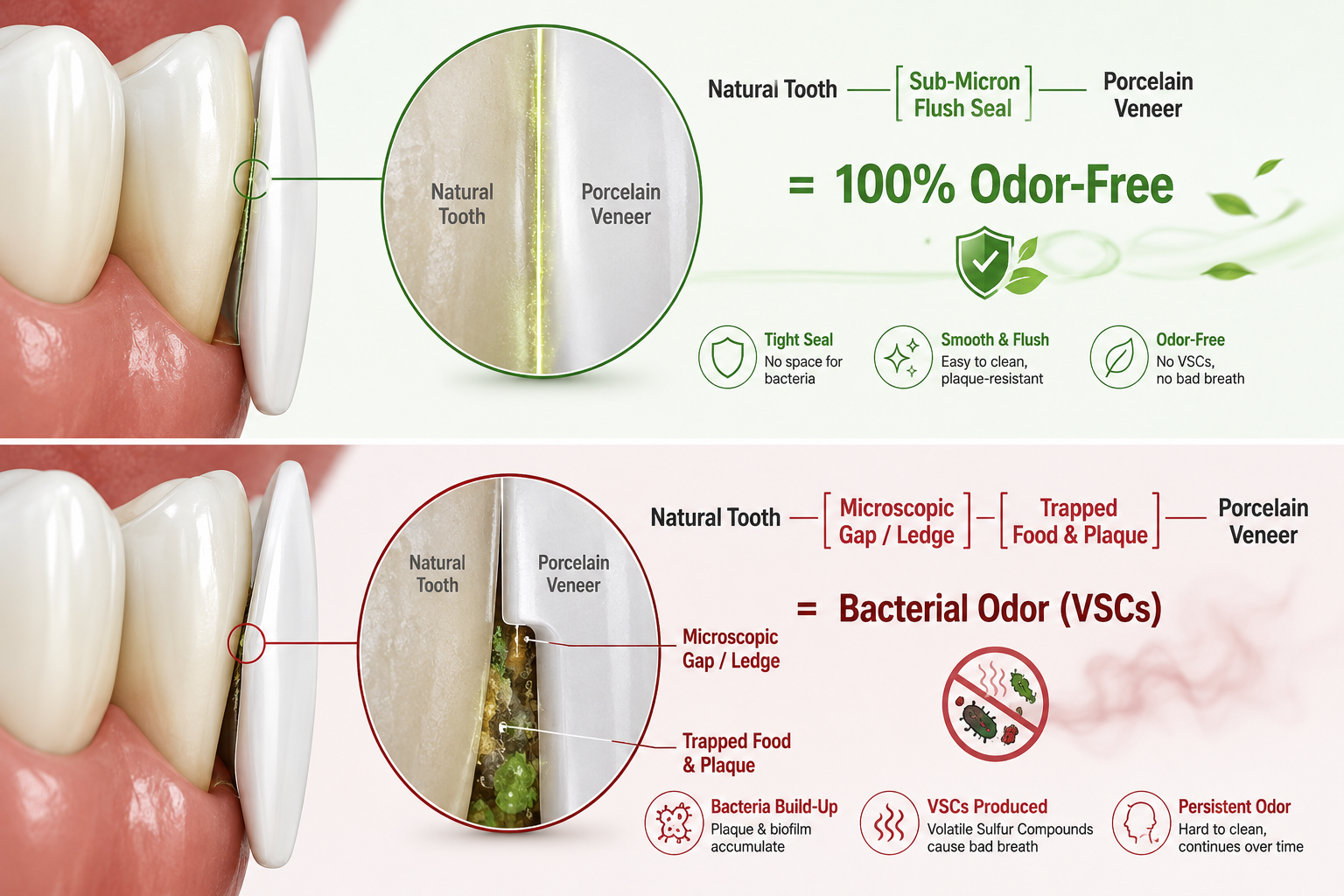
When a veneer isn't fitted perfectly to the tooth, it leaves behind a tiny, invisible space. A micro-gap. Think of it as a microscopic pothole. Toothbrush bristles are just too thick to sweep inside this gap. Because of that, it becomes the ultimate hiding spot for food debris and bacteria.
As these bacteria gorge on trapped proteins, they release strong gases. Clinically, these are Volatile Sulfur Compounds (VSCs).
In plain English? It’s the exact same chemical process that makes rotten eggs smell. Gross, but true.
Common Reasons Why Bacteria Build Up:
- A Poor Marginal Fit: The veneer doesn't sit completely flush with the gum line. This creates a tiny ledge. Plaque gets stuck here instantly.
- Leftover Dental Cement: During placement, dentists use a special resin to bond the veneer down. If excess glue isn't thoroughly cleaned from under your gums, it hardens. It basically turns into a magnet for plaque. The result? Inflamed gums and noticeable breath.
- Material Wear: Some composite materials wear down as the years go by. They lose their polish. The surface gets rougher, making it ridiculously easy for bacteria to cling on.
Porcelain vs. Composite: Why Material Matters
Does the type of veneer actually affect how your breath smells? Absolutely. Your choice of material plays a big role in long-term oral hygiene.
| Feature | Porcelain Veneers | Composite Veneers |
|---|---|---|
| Odour Absorption | Zero. The smooth, glass-like surface is non-porous. It simply can't absorb liquids, stains, or smells. | Moderate. The resin is slightly porous. It can absorb dietary fluids and odours over the years. |
| Plaque Resistance | High. Bacteria seriously struggle to stick to a polished ceramic glaze. | Moderate. As the resin wears down and gets rough, it attracts more plaque. |
| Precision of Fit | High accuracy. Often crafted digitally or in specialized labs to ensure a snug seal. | Operator-dependent. Sculpted by hand directly on the tooth. This leaves more room for slight gaps. |
How Land of Smiles Keeps Your Breath Fresh
At Land of Smiles, located in Jakarta's Sudirman 7.8 Tower, we believe a beautiful smile should also support excellent oral health. We minimize the risk of veneer-induced halitosis by sticking strictly to precise clinical protocols.
- Conservative Micro-Preparation: We don't just blindly alter teeth. We use conservative techniques to preserve as much of your healthy enamel as humanly possible. This helps ensure the veneer sits flush against your natural tooth structure. No ledges. Far fewer food traps.
- Digital Precision: Forget those messy, uncomfortable manual moulds. We utilize high-tech digital scanners to map your mouth. This allows for incredibly accurate fitting between your tooth and the porcelain, leaving minimal room for bacteria to sneak in.
- Thorough Cement Removal: When it’s finally time to bond the veneer, our team takes the time to carefully remove excess bonding cement from around the gumline and between the teeth before you leave the chair.
Getting a new smile should boost your confidence, not give you a totally new thing to stress over. By pairing non-porous porcelain with precise clinical execution, we aim to make sure your results feel and smell completely fresh.
- Discover how our Porcelain Veneers works.
- Learn about our Medical team and private suites.
- See the proof in our real patient Smile Transformation gallery.
Ready for a beautiful, fresh smile? Contact us via WhatsApp to schedule your Smile Consultation today.
Frequently Asked Questions
1. Do porcelain veneers start smelling as they get older?
Not even a little bit. Porcelain behaves just like glass, it’s non-porous. It literally cannot absorb smells or stains. If there’s an odour happening, it’s coming from plaque trapped around the edge of the veneer, not the actual ceramic itself.
2. Why do my old composite veneers taste bad?
Composite resin is slightly porous. Over years of eating and drinking, it can absorb fluids. Plus, if the surface isn't polished regularly by a dentist, it gets rough. That rough texture acts exactly like a sponge for odour-causing bacteria.
3. What’s the best way to clean veneers to prevent bad breath?
Treat them exactly like your natural teeth. Brush twice a day. Floss. And when you do, we actually prefer dental floss over a water flosser. Good old-fashioned string does a much better job of physically wiping away the sticky plaque hiding along the edges of your veneers than a water spray can.
4. Will the preparation process ruin my natural teeth?
Not when it's done right. Our micro-preparation technique is highly conservative. We only alter the necessary outer layer. When a porcelain veneer is sealed perfectly over the top, it actually acts as a shield for the underlying tooth.